
In honor of Santa Cruz poet and longtime Festival friend Joan Zimmerman, her friend and fellow poet, Ken Weisner, created a living collection of verse inspired by our season’s sounds.

You can read some of Joan’s poems on page 57 of our program book and her bio on the next page.
Music marks time—gathers, embraces, and endures it. Thunder in the tympani, nectar in the run of a flute; arpeggios of wonder, terror, and desire. When the orchestra plays, the world flies at us on a fierce wind. Abandoned to the music, you ask yourself—how long have my eyes been closed; how long since I’ve taken a breath?
—Gary Young, former Poet in Residence, first published in That’s What I Thought (2018)
The Cabrillo Festival has maintained a poet in residence program since the 1990’s, usually featuring local poets in the role including Joan, Farnaz Fatemi, Gary Young, and others. Attendees were invited, whether you attend an open rehearsal or a concert, to write a haiku or a poem in any form in response, in homage, in awe, or just in the spirit of the festival as you experienced it.
8.13.26
Lisa Allen Ortiz is the author of Stem, winner of the 2021 Idaho Prize judged by Ilya Kaminsky. She lives in Santa Cruz.
please enter quietly
august bees in hawthorne trees
center street
sidewalk cement steps— it’s
open rehearsal at the civic
you can walk right in
swinging doors
dim-hum-buzz-roar
those are oboes
that is a row of oboe players
their breath and knees
their chairs
and chairs and chairs and chairs, and a chair
for me and a chair
I saved for you
those are wind instruments
that is the conductor that is the artistic director
a table and a lamp
the trumpet player waiting for his part
trumpet on his knee, bell-baffled
then the french horns start, two tuba players
and those are violas now
that is a single viola player her resin bow her
steel-core and silver-bound viola strings
plainsong artifice performance of
wind in pasture buried rock and blister root
tide-pulled sand and the sea-cave of a human-heart
a beating like a falling like
a catch me of
and a percussionist
standing in the back with
some kind of golden castanet
and that is my breath
then two flutes and then a piccolo alone
and then
a single falling leaf
and I am in a chair
and I am a chair and I am in an auditorium
and I am an auditorium and there are cello players
sitting in a row of chairs
and I have saved
a chair for you
you can walk right in
you can just walk right in
—Lisa Allen Ortiz
8.8.2026
Patricia J. Machmiller is a poet, printmaker, and brush painter. She has two books of haiku and four books of haiga. A recent book is Zigzag of the Dragonfly: Writing the Haiku Way (Yuki Teikei Haiku Society, 2020). She is retired from the aerospace industry and lives in San Jose, California.
Coda
for J. Zimmerman
While the orchestra plays
a trout leaps from a mountain stream
thousands lose their Temporary Protected Status
several AI assistants go rogue
a little girl picks out a fairy princess lunch box for the new school year
a heat dome lingers over the west
on coastal dunes live-forevers bloom
in a small room a woman spends hours proofreading a bibliography
the ashes of a poet are spread in a lotus pond
someone writes a letter using a new fountain pen
an onshore breeze makes the sea sparkle
humpbacks spout
so much depends on the timing of the tuba and the timpani
so much . . .
—Patricia J. Machmiller
8.7.2026
Jessica Cohn of Santa Cruz recently published the award-winning collection Gratitude Diary.
Open Rehearsal
So, I was reading about Tin Pan Alley, a place in time
I knew nothing of while sitting in the dark with orchestra,
conductor, composers, directors, man in the wheelchair,
woman and support dog, the good, good toddler playing
shh shh mouse for his mother, fellows in audience, one ear,
one oar, one boat, one heart, one house. It was daylight
outside the rehearsal, another week in America coming to
a close, dark in the auditorium and elsewhere, more by
the hour. But here was proof: We still have new music.
You know, I played piano, clarinet, never well, but still
listened as though it were personal when the notes “Very
1916” and “Not 1935” were spoken, like any riddle or clue
I keep looking into it, like TIN PAN ALLEY, where sheet-
music cheeriness papered the first of World Wars and now
the start of a new concerto practiced in the civic auditorium.
I love the word CIVIC. One of my favorites, like GREEN.
Love sitting in sounds semi-circling the rapt who sneak into
seats for open rehearsal; OPEN too, the strings, my nerves,
the lowered light, the wood, metal, the breath box of one, two,
three, four, in and one, out; ascending creature, pulse, rainbow
promise, wanderlust, journeying, adagio, song, strings, oh,
cobble clock of ear, my abacus, taking the meter and measure
of things we may share by experience, their very shapes
conjured in vibration and air.
Inside every doorbell
The known sounds itself out
Stretches into symphony
during rehearsal
of Concerto for Orchestra
the maestro calls for
a more natural sound—
a passing train chimes in
8.7.2026
Jim Peterson is the author of the poetry collection Once in a Great While (2026) and a longtime member of the Cabrillo Festival Board.
A Lesson for a Student
After a phrase Cristian Mǎcelaru created to explain Brahms’ intentions
to a student conductor in the Conductors/Composers Workshop
“Brahms’ little pets”
he trots out to display,
not just to note them in passing but as if to say:
Here, here is my little pet!
And then, look, here is another—
as delightful as the first!
Are they not beautiful,
each and every one of them?
One pet sings, “Come frolic with me on the glen!”
Another says, “Look how cleverly I fooled you!”
The third one, a baby goat, confesses,
“I’ve stolen the lettuce from your salad bowl.”
Please, you must surrender to the frolic
and the tomfoolery, and mimic the theft of lettuce
with the courage of your baton;
let your heart put away its fears
so you may gambol with your pets—
in the sunlight, in the garden!
8.5.2026
Charlie McDowell is a trombonist comfortable in any subdivision or mixed meter and a retired professor of computer science from UCSC.
University
To get the quintuplet right
Hippopotamus
8.3.2026
from “Quatrains,” Jellaludin Rumi (1207-1273)
Today, like every other day, we wake up empty
and frightened. Don’t open the door to the study
and begin reading. Take down a musical instrument.
Let the beauty we love be what we do.
There are hundreds of ways to kneel and kiss the ground.
—from Unseen Rain: Quatrains of Rumi (Threshhold Books, 1986)
8.1.2026
written while listening to Sarah Hennies’ The Grain House.
Karen Warren is grateful to her parents for sharing their love of music and providing many years of lessons with local piano teacher Lillian Hangen.
![Tonight the tuba player wears blue suede shoes, and light sparkles on the wide silver rim of his instrument. Oh, deep and low the notes that rise from its curving bell, now growing sonorous as the strings pitch ever higher! before an interlude of silence. [beat] And then there goes my tuba man again, his fingers rocking gently their two-note refrain.](https://cabrillomusic.org/wp-content/uploads/2026/07/Screenshot-2026-08-08-at-7.34.05-AM-600x403.png)
8.1.2026
On Sarah Hennies’ The Grain House
It’s not about harvester ants
but she named it
for their underground
storehouses. My mind
stays in the underground air
pockets in the creaking earth.
A Jerusalem cricket,
Old Man, burrows in the heaving
layers, ears swelling,
a skeleton tapping wood.
The magma hums.
Waves wash pebbles
an ocean breathing, rolling
watery beast.
A horn call, bells.
Washed by sound
the darkened theater
lists like the steaming hold of a ship.
A lighthouse fades in the distance, fog
breaks into circling gulls.
The snare, oh!
And a cloud of insects rises,
shimmering heat above a great plain.
—Becky Roberts
8.1.2026
In Thursday’s open rehearsal, I was struck by the musical range and diversity in Pulse and the interactions—in body language as well as discussion—between the solo violinist, the orchestra, the conductor, and the composer. Even more so, after listening to the recording posted on the website, where I was delighted to hear Cristi Măcelaru and Lisa Bielawa talk about the “sneaky sounds” they wanted the musicians to create. These open rehearsals are a real gift to the community—as are the recordings. My profound thanks! — Beverly Acuff Momoi
PULSE fragments
outside
jackhammering concrete
inside
rehearsing nuance
with each swoop and bow
the violinist speaks
to the fiddler in me
between gesture
and intent
all those sneaky sounds
then the now
of wind chimes
that sudden thwack
7.30.2026
(Un)skeined
Attending the Philip Glass rehearsal for Symphony No. 15, “Lincoln”
You sit in a patch
of insight that
isn’t, & realize
that’s the point
of presence, to
be past breath-
counts & con-
jecture, past talk’s
know-it-all lectures,
to stumble onto
fields of non-
flowers devoid
of insects & sky
where the un-
breeze whispers
nothing much,
as the sun-shot
cloud of gnats
above the players
agitate the air—
a staccato vibrato
that’s throatless,
& you slip from
the skin of life
like a violin
unlatched
from its case,
like the cape
undraped
from a harp,
to unravel,
until you’re
travelling light.
7.28.2026
“I was struck by the clarinet soloist, Carlos Ferreira. Just appreciated the sounds that emerged from his instrument. I remembered doing this with the flute I played in Jr. High School. His playing also reminded me of our local Phil Yost’s playing when he was alive. His “Blackbird Tangos” is very special. Lots of squeaks and interesting rolls.”—Alison Woolpert
no scale note to start
the clarinet just whispers
—summer festival
7.28.2026
Cristi Măcelaru’s instructions to young conductors in his master class are sometimes technical, other times poetry. Who knew that Brahms’ Third Symphony was populated by puppies and goats? Who knew that signalling a fortepiano was touching a hot stove? Jacques Ibert wrote his flute concerto during the time of his father’s death.
The Conductor’s Workshop: Cristi Măcelaru (a found poem)
Jacques Ibert flute concerto, second movement (1933)
it’s a nod to the sarabande
where the second beat is more important
this has to be spiritual on another level
when you arrive at the C major
unspoken beauty, it has to be just incredible
it’s not about the beats
find a way where you create this intimacy and spirituality
it can be quite a bit more still
have you watched the ocean at 5:00 AM?
very small
that sound, that is what you created,
it doesn’t exist in words, it doesn’t exist in anything else
—kw
This elegy is for Joan Zimmerman, friend and predecessor poet with the festival.—Ken Weisner
FOR JOAN Z.
How grateful am I
for Joan, ordinary Joan
how I will miss her
*
Things that happened while you were dying
Dandelion seed
lands nearby, flies up again,
a woolly aphid
Walk through cloud of gnats
Milichiidae, Canyon Flies
form is everything
Most amusing, these gnats
I shake my head
like a dog
*
When the ego is gone,
how time
becomes music
*
Reading your haiku
after you died.
Your voice!
Shelby Graham is an artist and retired museum director living in Santa Cruz.
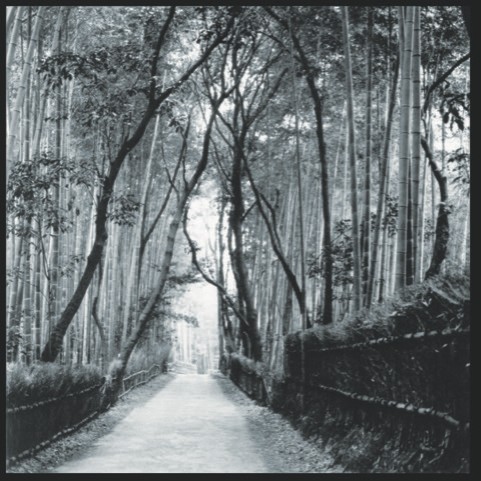
Every Tuesday morning, Joan Zimmerman led a group of us neighbors in Tai Chi, and near the end of each session we stood firm and rooted in place while allowing our bodies to sway like bamboo in the wind. In her final weeks, I gave her a large print of this image that I’d taken 35 years earlier, of Arashiyama Bamboo Grove in Kyoto, and we practiced Tai Chi together in front of it. I still practice before the pathway of bamboo, remembering Joan’s quiet resilience. —Shelby Graham
Listening for the Downbeat
Concerto for Violin with Percussion Orchestra (Lou Harrison)
August, 2025, Festival Orchestra w/ Jason Bruns
dustbins, spring coils,
tin cans, and a “double bass
laid on its back and struck with sticks”
twinkling glass wind chimes
twelve brake drums
six flower pots
sticks about to strike
double bass lounging
listening for the downbeat
the violin soars
—Linda Werner
7.28.26
Patti Sirens grew up in and outside New York City, where she discovered her love of poetry, studied at St. Marks Poetry Project, played bass and toured in several punk bands, worked for a publishing company and fell in love with the ocean at the Jersey shore. She moved to Santa Cruz in 1989, where she continues to write and perform spoken word, and in the 1990s was a founding member of Tribe Through Time, a women’s poetry performance group. Her first book of poetry, “Antarctica”, was published by Burning Bush Publications in 2000. “At The Cabrillo Music Festival” was first published in her second book, “Unrequited”, published by Uttered Chaos in 2019.
At The Cabrillo Music Festival
You shed your fuzzy green sweater
like an outer skin. I imagine
You unclothing a lovely unveiling
our limbs and torsos twining
Up the blue spine of an evening
what I mean to say is I’m hiding
desire wanting once again
what is just beyond my reach
to breach the humid air
between us
walking the invisible
high tension wire I can feel
the hairs on your arms
a breath away I want to
touch you. but don’t
dare disturb the pleasant
being-with we share
there’s an orchestra vibrating
the space we inhabit I close my eyes
and let the music and your nearness
flow through me my wanting
is a melody of horns and strings
an ocean pulsing
in and out of time I want
to float on that sea with you
discover our songs and rhythms
when the beat of the drums
draws me out of reverie
I realize it’s my own heart
playing its tympani
I long to be bold and impolite
take your hand
that’s coiled around
the arm rest reach up
touch your face
which is tilted
like a cat listening
to what is pleasing in the distance
break the silence of what’s not said
in the shimmer of that music
and kiss you on the mouth
7.25.26
A poem to get us started, by Stephen Kessler, who wrote this poem one night a few years ago at a Cabrillo concert. It is published in his most recent book, Last Call (2021).
New Music
Arrived early,
orchestra tuning in deep cacophony,
audience filing in finding their seats,
ushers handing out programs, reporters pulling out notebooks
to record what is unreportable
but portable,
you can carry a tune in your pocket with enough practice,
echoing and reflecting on what you hear and see,
a Botticelli in the front row,
her long rippling red locks a giveaway,
and the sounds of bows stroking long strings as the cellists
find their keys,
the official photographer, himself a celebrity,
angling in for the best shot,
old friends schmoozing in the wide aisles,
the rows far enough apart to allow illusions
of elbow room while we are cheek to cheek
and ear to ear in lines of folding seats,
except for mine, nobody to my right, a row of one’s own
in which to listen and write, all night if so inspired,
“no recording of any kind allowed” but I am nothing
if not outside the law politely defying
official guidelines and ground rules
while the music speaks for itself and is taken down
by a scribe incredulous at early rumblings of drums
less eloquent than the thunder they’re trying to emulate,
then the clouds
break for a bit of birdsong and a breeze
smelling of blood, hunters stalking dangerous
endangered species that might turn at any time
and devour them,
that’s how fast the tables
can turn and the diner is suddenly dinner
wondering how he was consumed by what he was pursuing,
it was a sting all along,
the conductor’s baton and the bows and drumsticks
conspiring to attack, to tickle, to provoke ironic rhythms
as infectious as they are fatal in the end.
Then the Steinway is rolled out and opened up,
microphone angled into its maw by a stagehand,
concertmaster fingering one note for orchestral orientation,
musicians lining up their tones for the composer,
the pianist and the Romanian maestro set to rip up
the virtuoso concerto
with aplomb, a young man’s first blast at a big band masterpiece,
or maybe just a flying chance, a nice try, close but no laurels
to smoke backstage afterward, and nothing to tap the ashes in
or get stoned on,
a long series of sighs
and wild bangs on the black-and-whites,
it’s all in his head, or was, and the writer has forced it
into the array of instruments and made them sound like his mind,
and it goes on like that, tracking his thoughts
and impressions, self-abstracted expressions
made concrete by execution,
and the sounds are killing me,
slamming and stabbing and pounding
my desire for pleasure to a pulp
with cosmic dissonance
to scramble whatever eggs I had left after all those frittati,
those tortillas, those omelets with too much of everything,
including drippings of the kitchen sink
where the buckets aren’t big enough
to catch it nor can ink begin to imitate its influence.
What I meant to say is what can’t be said
except maybe in what I swear was Esperanto
this morning on the car radio,
little traffic on Mission Street so early
and newspapers awaiting me at Safeway,
more information than I can use and it’s only Saturday,
tomorrow is when it will weigh a ton and I’ll have to tote it home
in a black bag like a dead body,
all the suffering in the world
spelled out in print and in pictures that blister credibility,
but you turn the page and there’s a jewelry ad,
or a picture of a watch where time has stopped
as long as you’re looking,
but it’s more than you can afford,
like the cost of this concerto with all its bells and whistles
way over your budget but you can’t afford to get over it either,
it is all over you
until it’s all over.